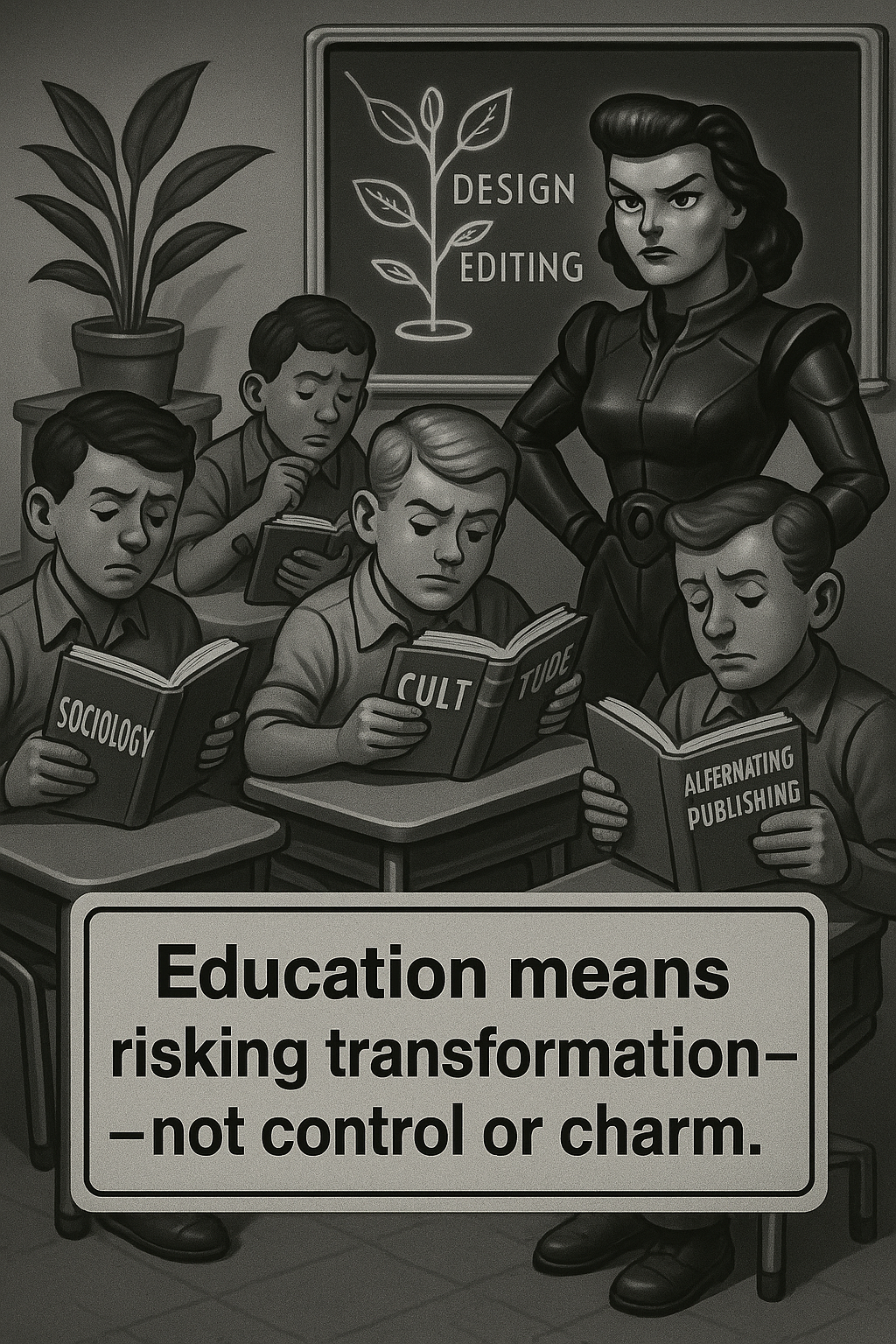
Prelude: A Tale of Two Schools
Let us begin in fragments.
In a not-so-distant future, education had fragmented into two dominant paradigms. One advanced beneath glass and code, the other bloomed in compost and contradiction.
Underground, beneath the high-speed corridors of the knowledge economy, The Academy of Seamless Integration offered education as optimization: seamless, continuous, monitored. Students were neurologically synced to adaptive modules. Their moods could be graphed; their learning curves flattened. Curiosity was celebrated—so long as it aligned with corporate innovation metrics. Discomfort was seen as inefficiency. Emotions were managed through interface calibration. Performance was peace. Graduation was absorption.
Above and around this world, however, another form of education had emerged. On the margins of industrial civilization, a school known only as The Rhizomatic Institute had taken root—distributed, adaptive, and post-institutional. There is an irony here, of course. A rhizome is, by definition, rootless—an underground stem of multiplicity and horizontal growth, opposed to the singular authority of the root. That the Institute could “take root” suggests a paradox: either the rhizome has betrayed its ontology, or the idea of rooting itself must be rethought. Perhaps it is not about fixity, but about situated resonance—what Deleuze and Guattari might call a territorialisation that resists capture.
At the Institute, education operated not as transmission but as co-formation. Students navigated curriculums structured by ecological rhythms, community urgencies, and relational entanglements. No classrooms, no diplomas—only experiences, mapped and metabolized. Teaching unfolded in forests, ruins, rooftops. Knowledge moved like weather. No walls defined its borders. It moved with the tides, settled where it was needed, then dispersed again like pollen.
What if education was no longer a system, but a site of unresolved desires? A friction between the hunger to grasp the world and the quiet knowledge that the world will not be grasped.
This is not a blueprint. It does not seek agreement. It offers dissonance, deliberately. You may find yourself pulled between competing tempos—one that demands acceleration, another that insists on listening. Some rhythms will feel familiar. Others will resist you.
Here, contradiction is not an error. It is the architecture.
Some voices will speak in metrics, others in mycelium. Some will promise seamless integration; others will compost the very notion of structure. But do not be fooled by appearances. These are not stable positions. What looks like opposition may be recursion. What seems like utopia may, on closer inspection, be fatigue in disguise.
And what of you?
You are not just reading this. You are being read—by the space between these visions, by the silences they produce, by the question they refuse to settle.
There is no map. Only a threshold.
The School of the Uncontrollable is not a place. It is what flickers between precision and multiplicity. It is what remains when neither control nor escape is enough. A door that opens inward. A curriculum of resonance, but not comfort.
As Hartmut Rosa reminds us, “what we really long for is not control, but resonance” (Rosa, 2020, p. 37). But resonance is not guaranteed. It cannot be engineered. It arrives—if it arrives—when the world responds to our reaching not with submission, but with echo.
Not all pedagogies declare themselves.
Not all futures arrive announced.
The Architecture of Control
In The Academy of Seamless Integration, control was not abstract. It was infrastructural. Learning modules responded to biometric data in real time, adjusting content pacing, tone, and difficulty. As Rosa and Scheuerman (2009) note, “the need for dynamic stabilization turns education into a system of perpetual reform” (p. 18).
By contrast, in The Rhizomatic Institute, unpredictability was designed in. Courses started only when participants reached attunement thresholds—not emotional, but ecological. As Gert Biesta (2013) emphasizes, “Education operates in the domain of the incalculable. It always entails the risk that nothing will happen” (p. 1).
The Curriculum of Relation
One course at The Rhizomatic Institute, titled Mourning as Method, was taught during lunar eclipses. Students studied extinction not through datasets, but by cultivating memorial plants for vanished species. The point was not simulation, but intimacy. Echoing bell hooks (1994), the pedagogy aimed to create “an atmosphere of open-minded intellectual inquiry that is joyous, rigorous, and communal” (p. 41).
But let’s pause. Is this mourning pedagogy a transformative practice or merely a poetic exercise for the privileged? A curriculum of plants and eclipses sounds admirable—unless one is a teacher in a mold-ridden classroom, paid to perform relationality for credits. Perhaps the mourning is not for the world, but for the lost promise of institutional critique.
In the Academy, relation was abstracted into affective analytics. Students were guided by AI coaches that monitored facial micro-expressions and tone modulation. Yet, as Sara Ahmed (2012) argues, “The performance of inclusion can serve to reproduce exclusion, maintaining whiteness as an institutional norm” (p. 151).
Epistemologies of the Otherwise
In design education, Ahmed Ansari (2019) proposes that “pluriversal design requires an ontological turn… recognizing many ways of being, knowing, and making” (p. 22). In the Academy, this was reduced to elective modules on Global Design Cultures. Students could select an Amazonian cosmology simulator or an Afrofuturist branding exercise.
At the Institute, design was not taught—it was enacted. One student embedded with a community of river guardians, documenting how the flow of sediment shaped spiritual cartographies. Escobar (2018) reminds us that “transition design must be based on the relationality of life itself” (p. 66).
Temporal Politics
Rosa’s concept of social acceleration is fully realized in the Academy. Degrees were condensed into week-long hyper-immersion protocols. “Speed,” writes Rosa, “is not a tool, but a mode of existence” (Rosa & Scheuerman, 2009, p. 31).
The Institute refused this ontology. Students could take years to complete a single learning arc. Their only clock was fungal: one cohort refused to finalize a project until their shared mycelium bed produced a black truffle. As Biesta (2013) notes, “The moment education becomes risk-free, it ceases to be education” (p. 3).
The Technological Companion
Fear of AI permeated both schools—but it was misplaced. The Academy feared disobedience: algorithms acting outside optimized parameters. The Institute feared abandonment: that AI, trained only on extraction, had forgotten how to care. Anne Balsamo (2011) writes, “Technological imagination is a cultural practice: it is how we construct the future through design” (p. 3).
At the Institute, students wrote code as if writing poetry. In one project, called Echo without Origin, an AI trained on lullabies was asked to generate mourning songs for extinct dialects. The question wasn’t whether the machine could feel, but whether it could help us remember how.
The Slowness of Understanding
Here, the text risks conflating slowness with virtue. But time is not equitably distributed. What appears as deep learning may also function as deferral, or worse: aestheticized withdrawal from the real violence of pedagogical inequity. To wait on a word is a privilege not afforded to all.
Understanding, in the Institute, unfolded over seasons. Paulo Freire (1970) insists that “only through communication can human life hold meaning” (p. 66). In one workshop, students were paired with a single word for an entire semester. They had to live with it, cook with it, grieve it.
Meanwhile, the Academy’s pedagogy aligned with Ivan Illich’s (1971) critique of institutional learning: “The school system has become the world religion of the modern man” (p. 9). Its theology was optimization; its god, seamlessness.
The Curriculum of After
In resistance to the algorithmic saturation of learning, a syllabus circulated: The Curriculum of After. It included modules such as:
- Unlearning Surveillance: Designing Shadows
- Listening to Fossils
- Kinesthetic Counter-Metrics
- Repair as Futurity
It referenced not just thinkers, but practices: “Moten & Harney’s (2013) notion of study as a mode of shared disbelief”; “hooks’ (1994) transgression as methodology”; and “Biesta’s (2013) call for virtuosity as a teaching ethic.”
Interlude I: Unauthorized Crossings
Not all borders were respected.
On a fogged evening, a small group of students from the Academy crossed into an unauthorized learning zone. Their neural guidance devices lost signal. They stumbled upon a shelter ring where Institute learners were listening to recordings of boiling water.
One visitor asked, “What’s the objective of this activity?”
Silence.
Another offered a tactile data visualization on evaporation. No response.
A learner from the Institute finally spoke: “We’re practicing purposeless listening.”
“But what do you learn?” the visitor insisted.
“It depends on what you’re unwilling to hear.”
For half an hour, they shared root tea. Then they parted, without record.
Interstitial Chapter: The Unfit
For six lunar cycles, Ayel moved unnoticed along both margins. At the Academy of Seamless Integration, they were known as “Unit 47-B”—high performance in affective simulation, low efficiency in procedural replication. At the Rhizomatic Institute, they were simply Ayel—or not addressed at all. Their presence was too marked for the group’s fluidity, too errant for the community’s center.
In a journal fragment recovered from a composting capsule, one could read:
“At the Academy, I was calibrated. At the Institute, I was silenced. What do I do with my ambivalence? How do I inhabit a pedagogy that wants me either too efficient or too symbolic?”
Ayel began to chart their own learning modes—micro-paths of deviation. They learned by failure, by counterexample, by insomnia. Once, they designed a project called Curriculum of Friction, where every task included its own scheduled interruption.
They never graduated from either system. But in an abandoned shelter, they left behind a hybrid artefact: a student record.
Hybrid Student Record: Ayel, n/e Pronoun: variable / misaligned
Age: between pedagogical temporalities
Location: intermittent
Personal Curriculum:
- Attempted listening with dissonant algorithms
- Mushroom cultivation on obsolete data surfaces
- Emotional translation of institutional metrics
- Cartographies of critical inattention
Learning Objective:
To be neither assimilated nor romanticized. Just to continue.
Interlude II: Echoes That Didn’t Settle
Weeks after the encounter between learners from both schools—one brief, one clumsy, one charged—a message began circulating through fragmented networks. It did not arrive via encrypted cloud or fungal signal, but as a voice message left on an obsolete public terminal. It was unsigned, anonymous, full of static:
“They offered me a root system. I gave them a sync profile. We didn’t understand each other. But for a moment, we held the same pause. I think that was something. I think that was enough.”
At the Academy, this caused mild unrest. The administration issued a minor update to the curriculum, introducing a pilot module called Resonant Misalignments. Participation was optional but encouraged. At the Institute, some cohorts began exploring “unscheduled convergence” as an experiment—short invitations to outsiders, not to join, but to witness. Not everyone agreed. Some feared dilution. Others feared forgetting.
For a brief moment, the border between optimization and uncertainty flickered—not erased, not crossed, but disturbed.
Coda: A Door That Opens Inward
In a later season, a former learner of the Rhizomatic Institute—now referred to only as Sol—began reappearing in fragments of conversation, scattered annotations, unclaimed tools left behind at temporary encampments. She had not returned to a place, but to a pattern—one marked by both resonance and exhaustion.
Sol’s presence was felt when learners stayed too long at a site, when the mycelial connections grew dense, and the need for movement stirred—but also when the practices of slowness, of deep relation, began to fray under their own weight. Some whispered of relational fatigue, of students retreating into silence not from contemplation but from saturation. Sol was not a solution but a symptom.
One evening, she gathered a group beneath a fractured canopy of wind-bent eucalyptus. Without speaking, she offered each learner a stone. No instruction, no symbolism. Just the act of giving.
Later, someone would write:
“The stone was not a metaphor. It was weight. It asked to be carried.”
The following morning, the school was gone. Dissolved. Only footprints remained, and the stones—some carried, some placed in circles, one balanced on a tree root, trembling in the wind.
Education, she had once said in a now-erased audio file, is not preparation for the world. It is the world rehearsing its capacity to change. It is a door that opens inward. And if you enter, you do not come back unchanged.
Not all doors are visible.
Not all teachers stay.
But the rhythm—of relation, refusal, and return—remains.
Post-Truth: On the Comforts of Educational Fiction
Let us speak with sharper contours.
If The School of the Uncontrollable reads like a fugue, it sometimes soothes more than it unsettles. Its speculative textures invite admiration—but occasionally evade contradiction. Is this a subversive blueprint, or simply a pastoral rebranding of critique?
The Rhizomatic Institute, for all its lyrical dispersal, risks embodying what Paulo Freire (1970) termed “visionary residue”: when the imagination of a future replaces the confrontation of the present. As Mark Fisher (2009) might add, it gestures toward the end of capitalism, yet leaves untouched the educational forms that sustain it.
Yes, it resists optimization. But it also luxuriates in boutique aesthetics—ritualised slowness, fungal metaphors, poetic code. These may enchant, but as Sara Ahmed (2012) warns, “diversity work that does not challenge power is not resistance—it is decoration.” One wonders: is this pedagogy of refusal or refuge?
Even the text’s frequent appeal to resonance (Rosa, 2020) risks becoming a therapeutic substitute for strategy. Gert Biesta (2013) reminds us: education should not merely move us—it must confront us.
Despite decolonial references, the Institute’s vision seems tailored to the mobile, time-rich, debt-free subject. The pedagogical “outside” it inhabits is not accessible to those for whom slowness is not a choice but a constraint. For some, walls protect more than they confine.
And what of Sol? She returns bearing metaphor, not method. Her gesture—silent, vanishing—reinforces the myth of the intuitive disruptor. But, as bell hooks (1994) contends, pedagogy demands confrontation, not charisma.
This isn’t rejection—it’s a call for friction. Less smooth utopia, more sharp edges. Less symbolism, more consequence.
Let the reader decide what still resists.
References
Ahmed, S. (2012). On being included: Racism and diversity in institutional life. Duke University Press.
Ansari, A. (2019). Decolonizing design through the perspectives of cosmological others. XRDS: Crossroads, The ACM Magazine for Students, 26(2), 20–24. https://doi.org/10.1145/3368435
Balsamo, A. (2011). Designing culture: The technological imagination at work. Duke University Press.
Biesta, G. J. J. (2013). The beautiful risk of education. Paradigm Publishers.
Escobar, A. (2018). Designs for the pluriverse: Radical interdependence, autonomy, and the making of worlds. Duke University Press.
Freire, P. (1970). Pedagogia do oprimido. Paz e Terra.
Harney, S., & Moten, F. (2013). The undercommons: Fugitive planning and Black study. Minor Compositions.
hooks, b. (1994). Teaching to transgress: Education as the practice of freedom. Routledge.
Illich, I. (1971). Deschooling society. Harper & Row.
Rosa, H. (2020). The uncontrollability of the world. Polity Press.
Rosa, H., & Henning, C. (Eds.). (2018). The good life beyond growth: New perspectives. Routledge.
Rosa, H., & Scheuerman, W. E. (Eds.). (2009). High-speed society: Social acceleration, power, and modernity. Penn State University Press.
 Publishing Futures * By Luís Alegre
Leave a comment