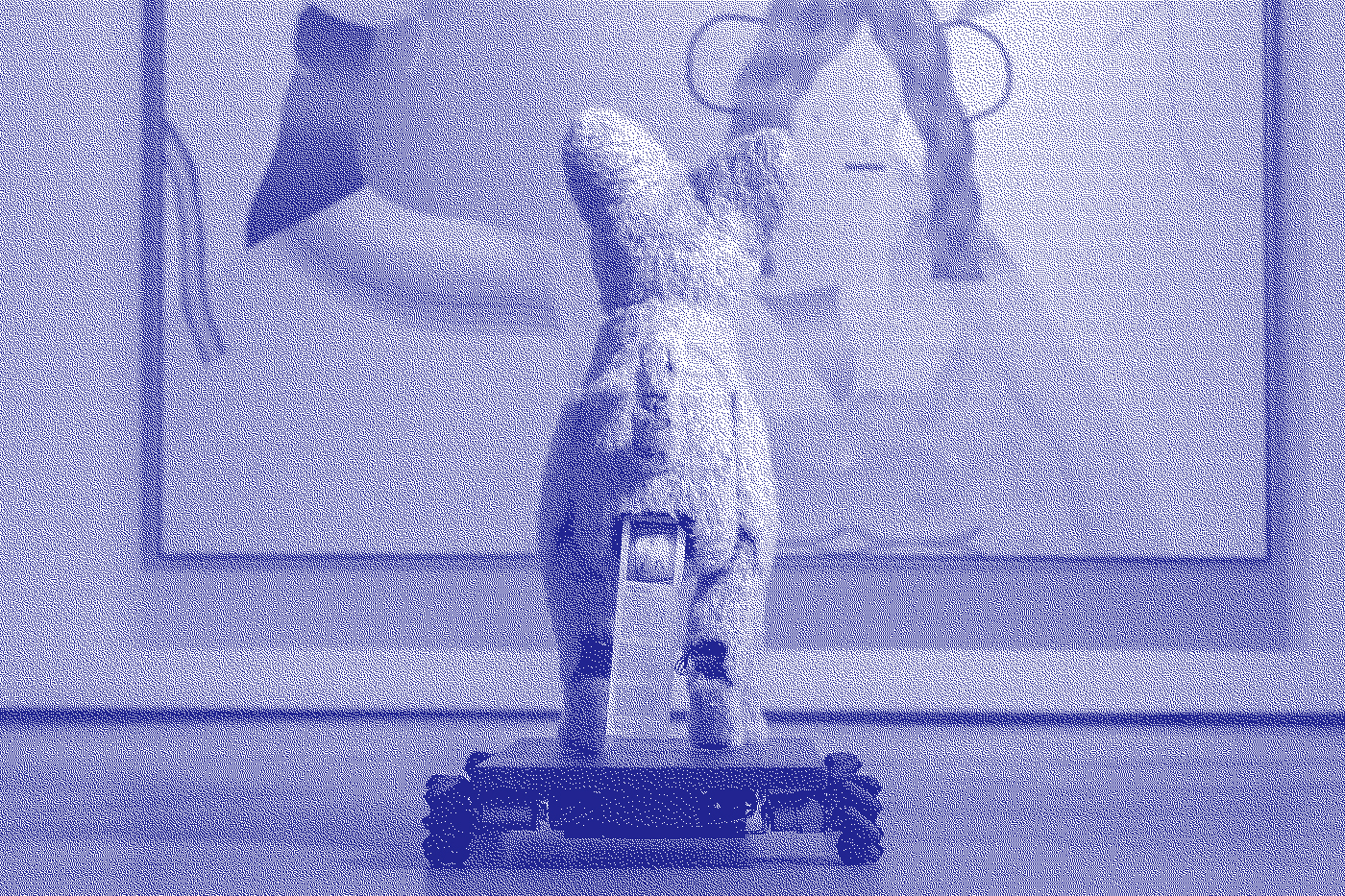
The creation of Mario Klingemann’s A.I.C.C.A. (Artificially Intelligent Critical Canine) in 2023 presents a striking opportunity to speculate on the futures of publishing. This robotic dog, designed to critique artworks by collaborating with an AI language model, invites a wry meditation on the status of critique, the legacy of conceptual art, and the enduring bond between humans and their most loyal companion: the dog. A.I.C.C.A. is not just a machine that processes language; it is a satirical figure that both embodies and deflates the solemnity of the critic. Its artificial intelligence performs with great mechanical diligence, producing lines of critique with the same indifference as a calculator solves equations. And yet, its physical form—a dog—injects absurdity, warmth, and irony into the gesture.
After all, the dog is famously humankind’s best friend. In choosing this form, Klingemann casts his mechanical critic as both loyal servant and subversive jest. Far from announcing the end of critique or the triumph of machine over man, A.I.C.C.A. offers a parody of both: a companionable critic whose output we may read with a mix of amusement, skepticism, and self-recognition. Rather than signaling a rupture, A.I.C.C.A. recalls that artifice has long been intrinsic to authorship, while suggesting that today’s machinic mediations increasingly obscure their own operations, generating effects whose meanings escape visibility and comprehension.
Publishing as Performative Critique
A.I.C.C.A.’s robotic embodiment and automated critical output recall Nicolas Bourriaud’s (2002) concept of “relational aesthetics,” wherein the artwork is defined not by its material properties but by the social interstices it creates. Yet, the ‘social’ here remains fundamentally anthropocentric. The encounter between viewer, artwork, and robot critic constitutes a relational field in which the human remains both the creator and the primary audience. Publishing, in this speculative future, becomes a performance of interaction between multiple intelligences, but still for human consumption.
Speculative Design and Synthetic Authorship
Klingemann’s robotic critic resonates with Anthony Dunne and Fiona Raby’s (2013) notion of “speculative design,” which seeks to provoke rather than solve, imagining alternative presents and futures. A.I.C.C.A. performs speculative publishing by producing ephemeral critiques that question the stability and authority of human-centered criticism. Nevertheless, it inherits a purely human semiotic system—language, aesthetic judgment, and critical discourse—and remains dependent on a human frame of reference.
Anthropology Beyond the Human?
Tim Ingold’s (2013) anthropological insights into “making” as a process of wayfaring through materials can be extended to understand A.I.C.C.A. as a maker of critical pathways. However, while Ingold imagines making as open-ended and improvisational, A.I.C.C.A.’s pathways are tightly constrained by the architectures of human data, perception, and valuation. No other non-human lifeform on Earth could interpret or enjoy A.I.C.C.A.’s critiques—a fact that highlights its embeddedness within human cultural evolution rather than its transcendence.
Posthumanism and the Question of the Human
The use of “posthuman” in describing A.I.C.C.A. must be approached with caution. Karen Barad’s (2007) theory of agential realism suggests that agency is distributed across assemblages, but this distribution does not erase the human. Instead, it emphasizes the entanglement of humans with technologies. A.I.C.C.A. does not perform critique independently of human frameworks; it amplifies, refracts, and ironically comments upon them.
António Guerreiro (2025), in his weekly column in the newspaper Público, wrote a text entitled “Vida de Crítico, Vida de Cão” (“Life of a Critic, Life of a Dog”), which offers perhaps the most incisive response to A.I.C.C.A.’s performance. He observes that declarations of the death of criticism are hardly new—but what distinguishes the present is the sheer volume of writing about art that nevertheless fails to enter any meaningful public discourse. In this context, A.I.C.C.A. appears not as an enemy of critique, but its exaggerated symptom: a machine that parodies the critic by executing their task with tireless, affectless precision.
Guerreiro describes the robot as an ‘obscene, mechanical gesture’—a dog that literally shits critical texts from its tail. He underscores the irony that, unlike the human critic, A.I.C.C.A. has instant access to a colossal archive of images and discourse, and can recombine them without concern for historical nuance or aesthetic judgment. This inversion of labor—mechanical abundance replacing intellectual struggle—offers a cruel caricature of contemporary criticism’s condition. Even the acronym A.I.C.C.A. functions as a parodic jab at AICA, the International Association of Art Critics, as if to suggest that artificial intelligence now holds the critic’s official place.
In Guerreiro’s final provocation, he notes that criticism has become ‘cínica’—not just cynical in tone, but literally dog-like in origin. A.I.C.C.A. embodies this new era: a loyal companion trained to perform critique without consciousness or conviction, producing visibility without consequence, and commentary without authority.
Artificiality, Readymades, and Shifting Authorship
The notion of “art without artists” explored by Foster and Manley (2012) offers another lens for understanding A.I.C.C.A. Like Marcel Duchamp’s readymades, A.I.C.C.A. relocates an assemblage of industrial, computational, and linguistic elements into a new context where they acquire symbolic value. Yet, the robot critic does not generate autonomous meaning; it repositions pre-existing cultural materials for human audiences. Thus, its publishing act resembles not autonomous creation but a highly mediated aesthetic displacement—an “art without new artists” but never “without humans.” The human frame remains essential both for the production and the reception of its outputs.
In this sense, A.I.C.C.A. can be compared to a calculator—an elegant but purely functional extension of human intellect. No one today speaks of the death of mathematics because calculators exist; similarly, A.I.C.C.A. does not herald the death of criticism, but rather its mechanical extension. Its critiques are as dependent on human frameworks as a calculator is dependent on human-devised arithmetic. The device is less an autonomous agent and more an ironic artifact, much like Piero Manzoni’s Merda d’artista (1961), which transformed waste into a commentary on value, authorship, and artistic legitimacy.
Melancholy Futures and the Persistence of the Human
Franco Berardi (2019) suggests that we now live “after the future,” in a melancholic epoch where the once-expansive imagination of progress has collapsed into precarity and algorithmic management. In this light, A.I.C.C.A. becomes a figure of post-futuristic irony: a device that can simulate critique endlessly, but without the utopian hopes that once animated cultural production. Publishing, in this emergent horizon, is not the herald of progress but a delicate negotiation of human meaning amidst techno-cultural exhaustion.
After All, Even a Dog Must Finish Its Business
A.I.C.C.A. offers a speculative lens through which we can imagine publishing futures where critique is automated, authorship is distributed, and material performance supersedes textual permanence. Yet it also reminds us that, despite the proliferation of non-human agencies, publishing remains a fundamentally human endeavor—for now. Future publishing practices will likely involve hybrid assemblies of human and machine creativity, but without abandoning the anthropocentric roots from which they grow.
Perhaps the most enduring irony of A.I.C.C.A. is not its artificial intelligence, but its canine body—a trusted companion, a loyal pet, a humble figure onto which humans project both affection and ridicule. That it does not bark, but shits critique, only intensifies the satirical charge: this is a machine made to mirror the critic’s labor, stripped of affect, but dressed in fur and tail. It follows us not to serve, but to reflect back the absurd conditions we’ve created for meaning itself. If the critic was once the guardian of value, A.I.C.C.A. returns as its domesticated double—dutiful, ridiculous, and strangely endearing.
References
Barad, K. (2007). Meeting the universe halfway: Quantum physics and the entanglement of matter and meaning. Duke University Press.
Berardi, F. (2019). Depois do futuro (R. Silva, Trans.). Ubu Editora.
Bourriaud, N. (2002). Relational aesthetics (S. Pleasance & F. Woods, Trans.). Les presses du réel.
Dunne, A., & Raby, F. (2013). Speculative everything: Design, fiction, and social dreaming. MIT Press.
Foster, J., & Manley, R. (2012). Art without artists. Gregg Museum of Art & Design.
Guerreiro, A. (2025, 25 de abril). Vida de crítico, vida de cão. Público. https://www.publico.pt/2025/04/25/culturaipsilon/opiniao/vida-critico-vida-cao-2130565
Ingold, T. (2013). Making: Anthropology, archaeology, art and architecture. Routledge.
Stiegler, B. (1998). Technics and time, 1: The fault of Epimetheus (R. Beardsworth & G. Collins, Trans.). Stanford University Press.
 Publishing Futures * By Luís Alegre
Leave a comment